
NLP is a field, not the next translation product
Natural language processing (NLP) covers how computers process human language. Translation is one task within it, alongside analysis, extraction and generation. Neural machine translation (NMT) is a family of methods; Transformer is an architecture; a large language model (LLM) can perform translation among other tasks. AI Translate is a service name, which alone does not identify its underlying model.From rules to bilingual data
The 1954 Georgetown–IBM demonstration showed that computers could translate Russian into English under controlled conditions. Early rule-based approaches used dictionaries and explicit grammar rules, making coverage expensive to maintain. IBM’s historical account describes this early work. Statistical machine translation (SMT) learned likely translations from paired texts instead of requiring every expression to be encoded by hand. It broadened coverage but still struggled with word order and distant dependencies. IBM’s overview explains these method families. Google Translate launched in 2006; Baidu Translate followed in 2011. Their growth helped make online translation an everyday utility. See Google’s anniversary account and Baidu’s official retrospective.Neural translation and the Transformer milestone
NMT learned mappings between languages using neural networks, improving the use of sentence-level information. Baidu records its internet NMT launch in 2015. Google announced its Translate NMT rollout in 2016, initially for eight language pairs. These were advances within established translation products, not a split between “traditional” companies and AI. Google’s announcement describes that transition. The 2017 paper Attention Is All You Need introduced the Transformer architecture built around attention. It provided a foundation for subsequent translation and language-model research; NMT already existed before it. LLMs make instruction-driven translation and rewriting more flexible, but can also add material or shift terminology. Faithful translation and creative adaptation require different acceptance criteria. Established products also incorporate newer models: Google announced 110 additional Translate languages in 2024, supported by PaLM 2. Google’s release illustrates this convergence.Why AI Translate matters to product teams
A consumer translation app and a paid developer API have different terms and interfaces. Google Translate is not interchangeable with Google Cloud Translation; Baidu’s consumer and developer offerings also differ. Evaluate AI Translate on its own API documentation and contract rather than assuming it is an official Google Cloud endpoint.Character budgets match content operations
AI Translate’s documented character allowances make it possible to estimate usage as content count × average source length × target languages. A catalog of 100,000 descriptions averaging 800 characters, translated into two languages, starts at 160 million processed characters, before retries and duplication. The plan record checked on August 26, 2026 lists Pro at $12 for 20 million characters, Plus at $60 for 200 million, and Max at $300 for two billion per month. At full allowance utilization, that corresponds to $0.60, $0.30 and $0.15 per million included characters. These are dated records, not a current quote; unused capacity increases effective cost. Check the listing before subscribing.Price comparison: as low as about 1/133 of Google NMT’s standard unit rate
Using the Google Cloud Translation NMT standard public rate of $20 per million characters, with each AI Translate allowance fully used:
At full Max-plan utilization, AI Translate’s character rate is about 1/133 of Google Cloud NMT’s standard public rate: a 99.25% lower unit price.
The ratio is
20 ÷ effective plan rate; the reduction is 1 − effective plan rate ÷ 20. AI Translate figures use the August 26, 2026 plan record above; Google’s standard rate was checked on October 17, 2026. This compares unit rates before Google’s first 500,000 free monthly characters, commitment discounts, negotiated rates, taxes and feature differences. It is not a promise of monthly bill savings. Unused plan capacity increases AI Translate’s actual unit cost.
Features suited to repeated translation tasks
Existing product materials list 249+ languages, source-language detection and batch text/HTML translation. These capabilities suit product descriptions, help content and support messages. Confirm the current language list, placeholders and markup behavior through testing. The materials describe use of Google AI. That is a provider statement, not independent quality certification, and does not establish a specific LLM, glossary support, private deployment or context memory.Test before implementing
The marketplace subscription and online testing workflow lets you inspect authentication, parameters and responses before adding a translation queue to your application. Use the listing’s OpenAPI specification rather than assuming a chat-completions interface.Historical usage to inform evaluation
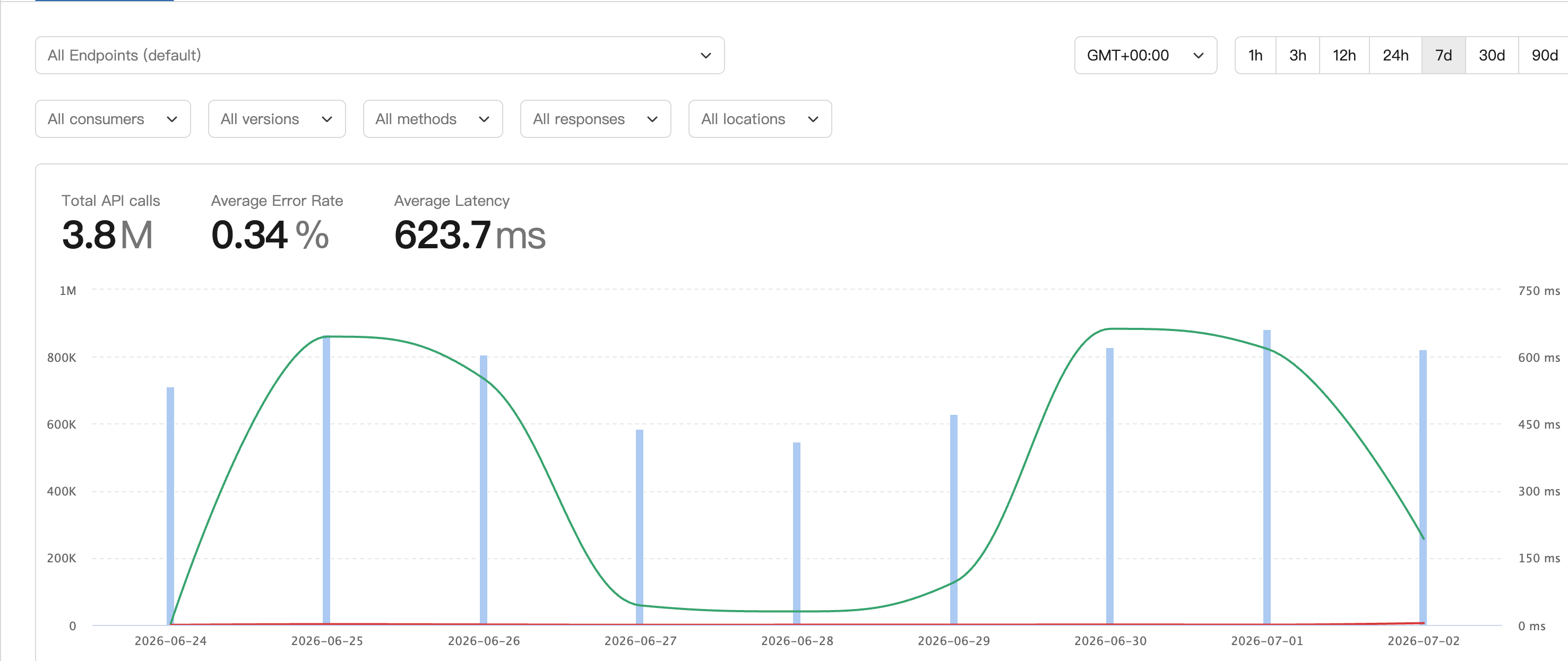
Performance in seconds: about 0.62 seconds on average historically
“About 0.62 seconds on average” is easier to read than milliseconds, but does not mean every request finishes within one second. There is no matched Google or Baidu test using the same texts, language pairs, region and concurrency, so no speed multiplier is claimed. Evaluate interactive use with P95/P99 latency and your own content.